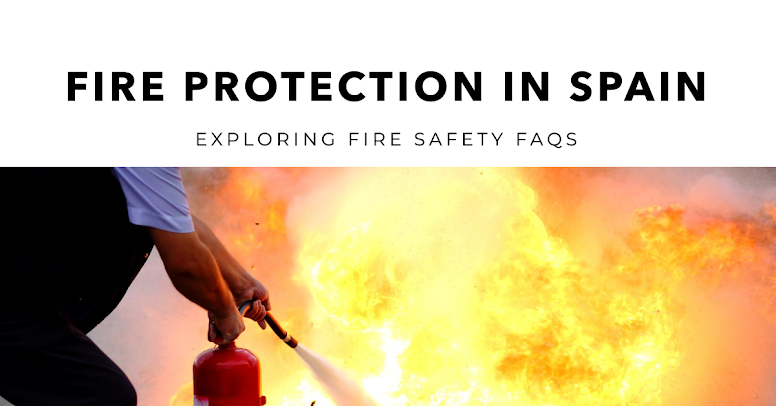
Fire protection in industrial buildings in Spain: Understanding the 2025 RSCIEI and Its Impact on Your Business
A key update for industrial operators in Spain
If you are a foreign business owner operating in Spain and located in an industrial building, fire protection is more than a legal requirement—it is part of your day-to-day responsibility. With the introduction of the RSCIEI 2025, many are wondering how this new regulation on fire protection in Spain affects their existing facilities and future plans.
A broader and clearer regulatory framework
The new regulation expands its scope and improves clarity. It now explicitly includes workshops, warehouses, auxiliary services, and small storage areas, meaning more businesses fall under fire safety regulations. The structure has also been reorganized to provide clearer definitions and easier application compared to the 2004 version .
Higher requirements and updated risk evaluation
Fire protection requirements in Spain have become more demanding. The updated fire load calculations may increase the intrinsic risk level of many establishments. As a result, some facilities previously classified as medium risk could now be considered higher risk, leading to stricter safety measures and more advanced fire protection systems .
Stronger protection measures with more flexibility
The RSCIEI 2025 reinforces both active and passive fire protection. It introduces more advanced detection systems, risk-based sprinkler requirements, and voice alarm systems in large or densely occupied spaces. At the same time, it improves compartmentalization, fire resistance, and evacuation conditions. Importantly, the regulation also allows performance-based design solutions, giving businesses flexibility as long as equivalent safety levels are demonstrated .
Do existing facilities need to adapt?
This is the key question. In general, existing industrial establishments do not need to fully adapt to the new technical requirements if they were already compliant under previous regulations. However, they must comply with updated obligations related to operation, maintenance, and inspections. The new regulation establishes a unified inspection period of every five years for all facilities, including those built before 2004 .

That said, adaptation becomes mandatory if the facility is expanded, modified, or if its intrinsic fire risk increases. In such cases, the new fire protection standards in Spain must be applied to the affected areas .
A modern approach to fire protection in Spain
Overall, the RSCIEI 2025 represents a significant step forward in fire protection in Spain. It modernizes the regulatory framework, increases safety standards, aligns with European regulations, and adapts to current industrial realities. For business owners, the key is clear: you may not need immediate upgrades, but staying compliant with inspections, maintenance, and future changes is essential to protect your business, your people, and your legal position.


Comments
Post a Comment